

Give a seven-year-old a regulation yellow ball and send them out on a full-size court. The first ball they receive bounces somewhere around their shoulders. They swing at it anyway, late and from above, and the rally is over after two or three shots. Nobody is learning tennis in that exchange. The child is learning to survive a ball that was designed for adults.
One number explains the mismatch better than any coaching manual. Researchers studying net height pointed out that the standard net, 0.91 m at the centre, is approximately 50% of a professional player’s height, but approximately 70% of the average 10-year-old’s height. Red, orange and green balls are the sport’s answer to that problem, and after more than a decade of use there is enough evidence to say what they do well, and where the case is thinner than many people assume.
What the rules actually say
The ITF’s Rules of Tennis are clear on one point: only the ball types specified in Appendix I “can be used in 10 and under tennis competition.” Those are the red ball, in a foam and a standard version, the orange ball and the green ball. A USTA Texas guide notes that its 10 and Under rules, aligned with those of USTA National and the ITF, became effective on January 1, 2012.
The simplest way to see the difference between the balls is the rebound test. A ball is dropped from 254 cm and has to bounce back within a set range. For the standard yellow ball that range is 135 to 147 cm. A green ball comes back 120 to 135 cm, an orange ball 105 to 120 cm, and a standard red ball only 90 to 105 cm. Less bounce means a ball that arrives lower and slower, which gives a small player time to get into position and room to swing.
The courts shrink as well. Under the same rules, a red court is between 10.97 and 12.80 m long and between 4.27 and 6.10 m wide, with a net between 0.800 and 0.838 m high at the centre. An orange court is between 17.68 and 18.29 m long and between 6.10 and 8.23 m wide. Green ball tennis moves to the full 23.77 m court. The rules also give recommendations: the red ball for players up to 8 years with a racket up to 23 inches, orange for players aged 8 to 10 with a racket of 23 to 25 inches, and green for “advanced players aged 9 to 10” with a racket of 25 to 26 inches.
One detail is often missed. The ball type is the compulsory part. The red and orange courts are described as courts that “may be used”, and the ages and racket lengths are recommendations, which leaves coaches and tournament organisers room to adapt.
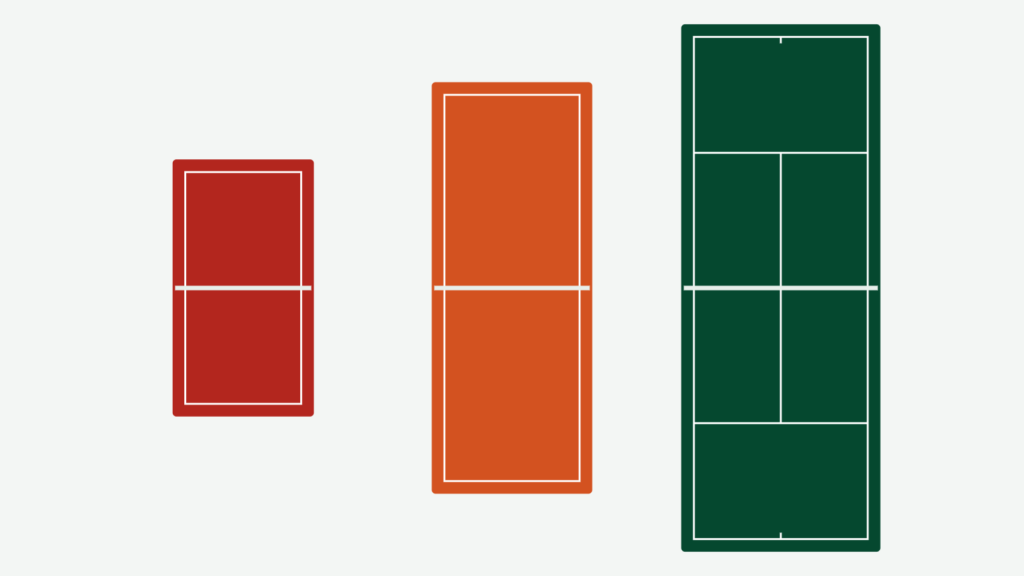
Why a slower ball changes the swing
The first thing a softer ball changes is where the child meets it. In a study comparing racquets of different sizes with balls of different compression, Buszard and colleagues found that hitting performance was best when the smallest racquet was combined with the ball with the least compression. That ball also encouraged two habits coaches spend years trying to build: swinging the racquet from low to high, and striking the ball in front of and to the side of the body.
The effect is not limited to beginners. When elite junior players used a ball with less compression, the modified ball increased rally speed, let players strike their groundstrokes at a lower, more comfortable height, and increased the number of balls played at the net. Ten boys and ten girls took part, so it is a small study, but it points the same way as the rest of the literature: a ball that bounces into the right zone lets children use the technique they are being taught.
A smaller study still, with eight children aged 7 to 9, compared an orange ball on a shorter court with a yellow ball on a full court. With the low compression balls, the children’s forehands scored higher. Eight players is too few to build a programme on, but the result fits.
Smaller court, bigger game
If anything, the court seems to matter more than the ball. Farrow and Reid compared beginners who practised with different combinations of ball and court size. Those who practised with a standard ball on a standard court were “afforded a significantly poorer learning experience” than the other groups, and the authors highlighted “the stronger learning effect generated by court scaling relative to the influence of ball type.”
Lowering the net changes how children compete. In one study, sixteen boys with an average age of 9.7 played 30-minute matches under four different conditions. When the net was scaled, they hit more winners, forced more errors, played more volleys, struck more shots from a comfortable height and stood further forward in the court. That is a description of attacking tennis, the kind a nine-year-old almost never gets to play on a full-size court.
There is a limit, though. In the net height study quoted at the start, the lowest net tested, 0.52 m, “reduced rally length significantly and therefore decreased hitting opportunities”. Scaling works because it brings the game into a child’s range, not because smaller is always better.
Scaling also changes which shots get practised. A study of the LTA’s Mini Tennis formats found that rallies at the red stage were roughly twice as long as at the full ball stage, 7.36 shots against 3.83. It also found that 66% of the shots at red were forehands, against 46% at full ball. Longer rallies are good news. A child who runs around every backhand for two years is not. The same researchers later reported that constraints designed by coaches “elicited more functional performance behaviours” than the standard Mini Tennis Red setup. The format is a starting point, and a coach still has to shape it.
What the research does not settle
The research does not close the case, though. A systematic review of 25 studies involving 989 children found that no study had examined scaled equipment over a practice period longer than 8 weeks, “so we cannot be certain that scaling equipment leads to greater learning in the long-term.” The same review noted that the ITF’s stage system “still requires empirical evidence to support each of its recommendations.”
Not every study found an advantage, either. An earlier trial with 14 children aged 5 to 11 reported “no difference in skill learning”, and some of the more experienced children saw the low compression balls as a step backwards. The last stage of the pathway has also been questioned: a study of twenty under-10 players concluded that the current green stage competition “should be redesigned”. And a review written by researchers whose own studies support scaling observed that junior programmes “have predominately been developed based on intuitive reasoning rather than empirical evidence”. It also left open whether more repetitions might mean a greater risk of overuse injuries.
None of this undoes the case for slower balls. It does change how confidently anyone should talk about the details, especially fixed ages and fixed timelines.
Moving up: skill, not birthdays
The most useful guidance on progression comes from the people who watch children play every week. In a 2025 scoping review, coaches reported that “transitions should be based on skill levels rather than age”, and the authors concluded that “the clinical eye of the coach is the main parameter for determining the transition.” The USTA’s rules material puts it in plainer words: it is not a “race” to the Green Ball Division.
In practice, that means looking for evidence on the court rather than counting birthdays. Before moving a child up, ask a few honest questions:
- Can they keep a cooperative rally going with a partner of the same level, using both forehands and backhands?
- Can they start the point with a reliable overhead serve on their current court?
- Do they move the ball around on purpose, and do they come forward when a ball lands short?
- Are matches at their current stage still a challenge, or are they winning points without having to think?
If most of the answers are no, a faster ball will not solve anything. It will hide the gaps under a higher bounce and send the child back to the late, high contact and short rallies the whole system was built to avoid. Staying too long has a cost as well, mostly in motivation, which is why the decision belongs to someone who watches the child play rather than to the calendar.
A seven-year-old rallying with a red ball on a short court is playing the same game as the professionals on television: building points, changing direction, coming to the net. That is what the stages are for, and it is worth protecting from the rush to the yellow ball.
Sources
- International Tennis Federation (2025). Rules of Tennis 2026: Rule 1, Appendix I and Appendix VIII. itftennis.com
- USTA Texas (2016). Junior Know the Rules: 10 and Under Tennis. usta.com
- USTA. The Perfect Fit (court sizes for each ball colour). usta.com
- Farrow and Reid (2010). The effect of equipment scaling on the skill acquisition of beginning tennis players. Journal of Sports Sciences, 28(7), 723-732. PubMed
- Buszard, Farrow, Reid and Masters (2014). Modifying equipment in early skill development: a tennis perspective. Research Quarterly for Exercise and Sport, 85(2), 218-225. PubMed
- Larson and Guggenheimer (2013). The effects of scaling tennis equipment on the forehand groundstroke performance of children. Journal of Sports Science and Medicine, 12(2), 323-331. PMC
- Kachel, Buszard and Reid (2015). The effect of ball compression on the match-play characteristics of elite junior tennis players. Journal of Sports Sciences, 33(3), 320-326. PubMed
- Timmerman and colleagues (2015). The effect of equipment scaling on children’s sport performance: the case for tennis. Journal of Sports Sciences, 33(10), 1093-1100. PubMed
- Limpens and colleagues (2018). Scaling constraints in junior tennis: the influence of net height on skilled players’ match-play performance. Research Quarterly for Exercise and Sport, 89(1), 1-10. PubMed
- Fitzpatrick, Davids and Stone (2017). Effects of Lawn Tennis Association mini tennis as task constraints on children’s match-play characteristics. Journal of Sports Sciences, 35(22), 2204-2210. PubMed
- Fitzpatrick, Davids and Stone (2018). Effects of scaling task constraints on emergent behaviours in children’s racquet sports performance. Human Movement Science, 58, 80-87. PubMed
- Buszard, Reid, Masters and Farrow (2016). Scaling the equipment and play area in children’s sport to improve motor skill acquisition. Sports Medicine, 46(6), 829-843. PMC
- Hammond and Smith (2006). Low compression tennis balls and skill development. Journal of Sports Science and Medicine, 5(4), 575-581. PMC
- Gimenez-Egido, Ortega-Toro, Palao and Verdú-Conesa (2019). Effect of modification rules in competition on technical-tactical action in young tennis players (under-10). Frontiers in Psychology, 10, 2789. PMC
- Buszard, Farrow and Reid (2019). Designing junior sport to maximize potential: the knowns, unknowns, and paradoxes of scaling sport. Frontiers in Psychology, 10, 2878. PMC
- Piquer-Piquer, Crespo, Ramón-Llin and Guzmán (2025). Exploring the impact of equipment modifications on novice tennis players: a scoping review. Frontiers in Psychology, 16, 1536427. PMC