

In American college tennis, the match does not start with singles. Under the current ITA rulebook, published by the NCAA as the official rule book for the championship, a dual match is “three doubles followed by six singles”. The team that wins two of the three doubles matches takes one point, each singles match is worth a point, and four points win the match. For a junior who hopes to play in the United States one day, the first thing a college coach will ask them to do on a match day is play doubles.
That alone is a practical reason to take doubles seriously. The better reasons are about what the game teaches, and they apply to juniors who will never go near a college campus.
Doubles is part of the pathway
Doubles is not a side event in junior tennis. The ITF World Tennis Tour Juniors regulations for 2026 list boys’ and girls’ doubles among the events to be held, and doubles results count toward the combined world junior ranking. They count at a discount, though: the ranking includes “one quarter (¼) of the six best doubles results”. A junior with limited time and money can see that arithmetic as clearly as anyone, which is one reason doubles can drift down the list of priorities.
The format itself is worth a look, because it explains why doubles is such good pressure training. In ITF junior events, each doubles match is “two Tie-Break sets and a Match Tie-Break (10 point) in place of a third set”, and “No-Ad scoring shall be used.” Deuce becomes a single deciding point, and a whole match can turn on a ten-point tie-break. In college tennis the doubles matches are single sets of six games with a tie-break at six-all. Short formats mean that almost every service game contains a point that really matters.
Team competitions tell a different story. Coach education slides from the LTA note that six of eleven ties at the 2024 Billie Jean King Cup Finals went to a deciding doubles. When a nation’s result comes down to one match, it is very often a doubles match.
What doubles concentrates
The most useful way to think about doubles is as a game that concentrates certain skills. A study of 34 ATP doubles matches found that, compared with singles, doubles had fewer strokes per point, and that “winning shots and winning serves are the most frequent patterns to finish the point”. The authors underline “the great importance of the serve in doubles, as well as the relevance of using offensive tactics.” In professional doubles studied across 303 matches, serving teams won 66.2% of service points in the men’s game and 57.2% in the women’s.
Doubles also puts players at the net far more often. In an analysis of 21 women’s doubles matches at three Grand Slams, 36.1% of points finished from the net zone, and the most common finishing shot was the forehand volley. The authors give the simple reason: “there is always two of the four players at the net for the beginning of each point.” A singles player who spends most of the year at the baseline can go weeks without hitting a volley under pressure. In doubles, the volley is part of almost every service game.
Then there is the part of doubles that has no equivalent in singles: a partner. In a study of NCAA Division I women’s doubles teams, most communications were emotional or action statements, and “winning teams exchanged twice as many messages as losing teams.” That is a correlation, not proof that talking wins matches. It does describe a skill that matters on court and rarely gets practised: agreeing on a plan in a few seconds and then carrying it out together.
What the coaching pathways recommend
The national federations build doubles into their junior pathways from an early age. A USTA development poster for players aged 4 to 11 includes, at the orange stage, “Doubles: communication, basic positions, use of angles” and, at the green stage, “changing positions, role of the net player, both players to the net”.
The LTA’s 2025 coach forums went further, with a session built around the objective to “understand the importance of training doubles net play early for children” and the advice to add doubles into junior programmes through coaching sessions, social match play and team challenges. One slide quotes a motor skill development expert arguing that doubles “doubles-up” net skills that “also transfer to singles”. That last claim is an expert opinion, not a research finding, and it is worth saying so plainly.
What doubles does not do
An honest case for doubles has to include its limits. The evidence above comes from professional, college and adult players; there is no study showing that more doubles improves a junior’s singles results, serve placement or return under pressure. The argument rests on what the game asks players to do, not on a trial that measured the outcome.
Doubles is also physically lighter. When adults played 60-minute games of singles, doubles and padel, heart rate, perceived exertion and physical load were higher in singles, which also involved more forehands and backhands. In a study of 48 youth players aged around 17, interval training in a singles format produced larger anaerobic gains than a doubles format, while aerobic improvements were similar across formats. Doubles complements singles. It does not replace the running.
Even at the top, the game keeps changing. A 2015 paper notes, citing earlier authors, that less net play now happens in doubles than in previous years, especially in the women’s game, and in the Grand Slam study above more than half of the points still ended from the baseline or mid-court.
Making doubles part of the week
None of this needs a new programme. A few changes to an ordinary week are enough:
- Play at least one set of doubles in practice each week, with the same seriousness as a singles set.
- Rotate roles, so every player spends time as the server’s partner at the net and as the returner’s partner.
- Practise serving with a partner standing at the net, which makes placement matter in a way an empty court does not.
- Agree on one plan before every point, even a simple one, and talk briefly after it.
- Enter the doubles draw at tournaments rather than treating it as optional.
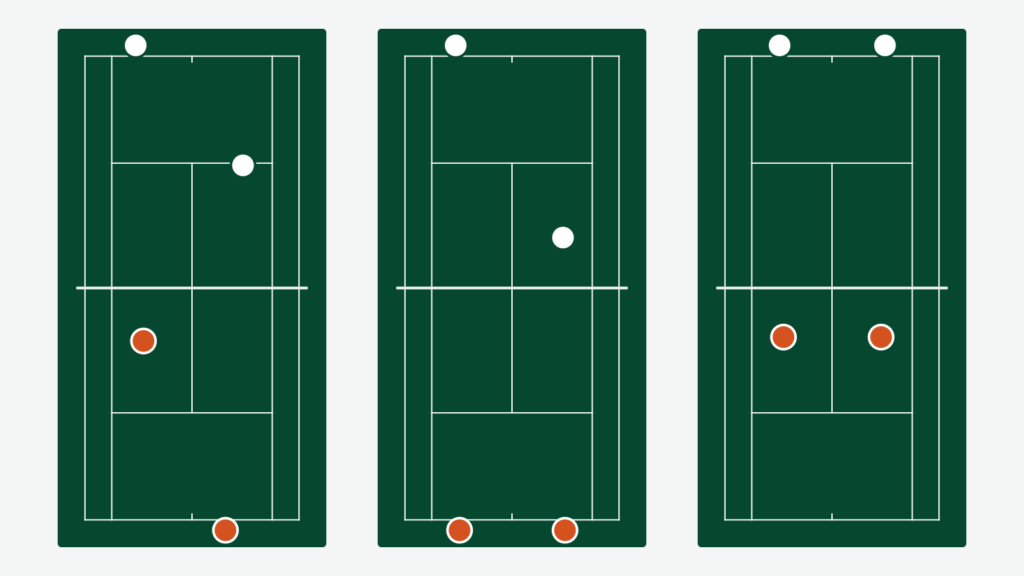
The three formations in the diagram above make a natural progression. Younger players can start with one up and one back, which keeps roles simple: one player rallies, the other learns when to move and when to poach. Defending with both players back comes next, usually against a serve or return the pair cannot yet handle at the net. Getting both players forward is the hardest step, because it needs a first volley, a good partner and an agreement about who covers the middle. That sequence mirrors the USTA pathway quoted above, which moves from basic positions at the orange stage to changing positions and both players at the net at the green stage.
Juniors who play doubles regularly get many more serves, returns and volleys under real pressure, plus practice at deciding things with someone else. Those are useful in singles, essential in college tennis and part of the game at every level. A weekly set of doubles is a small price for all of that.
Sources
- Intercollegiate Tennis Association (2025). 2025-26 ITA Rulebook, Regulation I.B. Published by the NCAA as the official rule book for the 2025-26 tennis championship. ncaa.org
- International Tennis Federation (2025). ITF World Tennis Tour Juniors 2026 Regulations. itftennis.com
- Lawn Tennis Association (2025). Coach Forums 2025: Doubles Net Play, Red to Tour (slides). lta.org.uk
- USTA (2013). Developing Tennis Players, Ages 4-11 (poster). usta.com
- Martínez-Gallego, Crespo, Ramón-Llin, Micó and Guzmán (2020). Men’s doubles professional tennis on hard courts: game structure and point ending characteristics. Journal of Human Sport and Exercise, 15(3), 633-642. uv.es
- Borderias, Iglesias, Martínez-Gallego and Baiget (2024). Comparison of the finishing shot and ending zone of points in Grand Slam matches of women’s doubles tennis: a cross-sectional study. PLoS ONE, 19(5), e0303437. PMC
- Lausic, Tenenbaum, Eccles, Jeong and Johnson (2009). Intrateam communication and performance in doubles tennis. Research Quarterly for Exercise and Sport, 80(2), 281-290. PubMed
- Carboch and Kocib (2015). A comparison of service efficiency between players of male and female doubles at professional tennis tournaments. Acta Universitatis Carolinae Kinanthropologica, 51(2), 56-62. karolinum.cz
- Armstrong, Reid, Beale and Girard (2023). A comparison of match load between padel and singles and doubles tennis. International Journal of Sports Physiology and Performance, 18(5), 512-522. PubMed
- Qin, Qian and Zhou (2026). Comparing the effects of singles vs. doubles high-intensity on-court tennis training and regular high-intensity interval training on aerobic and anaerobic performance adaptations: a randomized, parallel-controlled study. Journal of Sports Science and Medicine, 25(1), 159-171. PubMed