
Picture a club match at 30-all. A long rally ends with the server’s forehand in the net, and now it is break point. One version of that player walks straight back to the baseline, still replaying the miss, bounces the ball twice and serves. Another turns away from the court, breathes out, wipes their hands on the towel, decides where the serve is going and only then steps up to the line.
Both players had the same amount of time. Only one of them used it. How long that time is, and what to do with it, are both better documented than most players realise.
Twenty-five seconds, by the rules
The Rules of Tennis are exact about the gap. Rule 29 of the ITF rules states: “Between points, a maximum of twenty-five (25) seconds is allowed.” The rule also defines when that time runs: “The maximum time starts from the moment that one point finishes until the first service is struck for the next point.” And it closes the obvious loophole after a draining rally: “No extra time shall be given to allow a player to recover condition.”
The limit used to be shorter. In June 2019 the ITF Board supported a proposal “to increase the maximum time between points from 20 seconds to 25 seconds”, and the foreword to the USTA’s 2020 rules handbook, Friend at Court, noted “one substantive change”: “The ITF has changed the maximum time between points from 20 seconds to 25 seconds.” Some coaching material still mentions 20 seconds, so a player who learned the rules years ago may be working from an old number.
The clock on court
Before the shot clock, the limit was widely ignored at the top of the game. A study of 3475 serves in the men’s singles at the 2016 Australian Open, when the Grand Slam limit was still 20 seconds, found an average of 21.5 seconds between points. The limit was exceeded on 58.5% of serves, and only two of those violations, 0.1%, were penalised by the umpire.
Visible clocks changed that. In November 2017 the WTA announced that “From the Australian Open 2018, a shot clock will be utilized in between points, and the time permitted increased to 25 seconds.” The following July, a joint release from the USTA, ATP and WTA explained how the clock would run at tour events that summer and at the US Open: “Following the point, the score will be entered, the Chair Umpire will announce the score, and then start the 25 second-clock.”
That detail matters. The 2023 clock procedures for ATP, Grand Slam, ITF and WTA events say the umpire should consider the length of the point and “can therefore delay the announcement of the score if appropriate.” After a long rally on television, the total gap can be longer than 25 seconds. In a club match the time runs from the end of the point, so the professionals are not a reliable guide to how much time a club player has.
Where most of a match happens
Those gaps add up. A review of the physical demands of tennis found that the time the ball is actually in play “amounts to 20-30% on clay courts and 10-15% on fast court surfaces.” Rallies typically lasted 5 to 10 seconds and the rests between them 10 to 20 seconds, figures gathered under the old 20-second limit. The rest of the match is spent walking, towelling, sitting at changeovers and waiting.
Jim Loehr, who died in April 2026 at the age of 83, built his best-known contribution to tennis on that fact. As a USTA tribute puts it, the approach that became known as the 16-second cure came from a simple observation: “most of a tennis match happens between points.”
The same review contains a finding that surprises many players. Heart rate “is not significantly different between rallying and recovery, or else it is even slightly increased during the recovery periods between rallies.” The body gets little real rest in 25 seconds, and the rules do not offer more time for that purpose. What the gap does offer is time for the mind: to let the last point go, settle down and choose what to do next.
What a good routine looks like
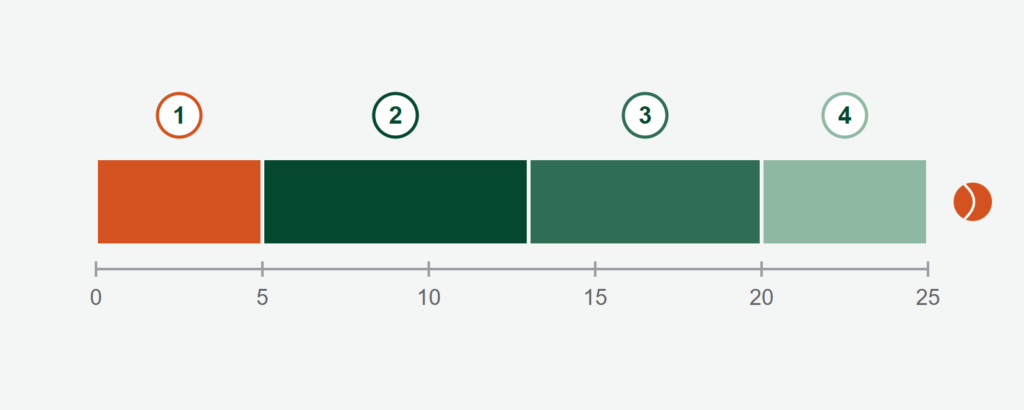
The LTA’s guide to mental and emotional skills, by Harwood and Thrower, calls between-point routines “the 20 second ‘engine room’ for mental planning and emotional control”, still using the old figure. It describes three parts. First comes “an acceptance or reinforcement phase”. Then “a recovery and composure element where the player physically re-groups, uses the towel, breathes rhythmically to control heart rate and attention.” Last is “a planning and intentions phase where the player evaluates the situation and any tactical strategy”. Before the point begins, “the player narrows their attention to an external focal point such as the ball in the opponent’s hand when receiving serve”.
Loehr’s version, as the USTA describes it, has four phases that “successful players used between points”: “a positive physical response, relaxation, mental preparation and ritual.” The labels differ, but the sequence is close. Respond to the point that has just ended, settle the body, make a plan, then go through a fixed ritual with attention on the ball.
Neither model is a tested protocol. The USTA page presents Loehr’s phases as what he observed in successful players and cites no study behind them, and the LTA guide is practical advice written for parents. They are sensible coaching frameworks. The evidence that routines help comes from other research.
What the research says about routines
Most studies look at pre-performance routines: the set sequence of actions and thoughts a player goes through before a skill such as the serve. A meta-analysis that pooled 112 effect sizes, with data from 15 sports and 800 athletes, found a small effect in studies that compared performance before and after a routine was introduced (SMC = 0.31). In controlled experiments the effects were moderate to large, both under low pressure (Hedges’ g = 0.64) and under pressure (g = 0.70). They did not depend on the type of routine, age, gender or skill level.
Put simply, routines tend to help, they hold up under pressure, and they are not reserved for elite players. The caution is that these studies cover routines before a single skill in many sports, not the whole 25 seconds between tennis points.
Tennis has smaller studies. In one, 11 players aged 11 to 14 took part in an intervention built around a pre-serve routine. Afterwards their double faults fell by close to half, and their record in service games went from 8 won and 24 lost to 25 won and 20 lost. Their first-serve percentage did not change, and the study had no control group, so other factors may explain part of the improvement. It is an encouraging result, not proof.
Building a routine that fits
The LTA guide says between-point routines “represent the cornerstone of a young player’s self-regulation and they need to be practiced.” A routine is a skill like any other, so it belongs in practice before it is trusted in a match. One way to build it, following the phases above:
- Close the last point. Accept it if it went badly, reinforce it if it went well, and turn away from the net.
- Recover. Walk slowly, use the towel if you need it and breathe out slowly a few times. The heart rate will not fall much, but attention can settle.
- Plan one thing: a target for the serve, a position for the return, or a pattern for the first two shots.
- Go through the same short ritual every time, then fix your attention on the ball, in your hand before the serve or in the opponent’s hand before the return.
- Rehearse the whole routine in practice sets, including straight after long rallies, until it fits comfortably inside the time.
Keep a short version for the hardest moments. Under the ITF rule the time starts when the point ends, and the rule is clear that a long rally does not earn extra time. A routine that needs 30 seconds will break the rules at exactly the moment it is most needed.
Parents and coaches can help by watching what a player does between points as well as during them, and by agreeing on the routine in a calm moment at practice rather than in the middle of a match.
A match is made of points, but it is also made of the pauses between them, and every player gets far more of those than winning shots. Twenty-five seconds is not long. Used well, it is enough to leave one point behind and start the next one with a plan.
Sources
- International Tennis Federation (2026). ITF Rules of Tennis 2026, Rule 29: Continuous Play. itftennis.com
- International Tennis Federation (2019). Board of Directors meeting summary, Paris, 3-4 June 2019. itftennis.com
- USTA (2020). Friend at Court 2020, Foreword. ustahawaii.com
- WTA (2017). New Grand Slam rules to be introduced in 2018-19. wtatennis.com, 24 November 2017. wtatennis.com
- USTA, ATP and WTA (2018). USTA, ATP and WTA implement rules innovations at events throughout summer. Joint press release, 11 July 2018. atptour.com
- Serve/Shot Clock Procedures for ATP, Grand Slam, ITF and WTA events (2023). Published by the Lawn Tennis Association for officials. lta.org.uk
- Kolbinger, Großmann and Lames (2019). A closer look at the prevalence of time rule violations and the inter-point time in men’s Grand Slam tennis. Journal of Sports Analytics, 5(2), 75-84. doi.org/10.3233/JSA-180277
- Fernandez, Mendez-Villanueva and Pluim (2006). Intensity of tennis match play. British Journal of Sports Medicine, 40(5), 387-391. doi.org/10.1136/bjsm.2005.023168
- Harwood and Thrower. Mental and emotional skills: a guide for parents. Lawn Tennis Association. lta.org.uk
- USTA (2026). Jim Loehr’s lasting lessons for tennis coaches. ustacoaching.com
- Rupprecht, Tran and Gröpel (2024). The effectiveness of pre-performance routines in sports: a meta-analysis. International Review of Sport and Exercise Psychology, 17(1), 39-64. doi.org/10.1080/1750984X.2021.1944271
- University of Vienna. Press release on the meta-analysis by Rupprecht, Tran and Gröpel. EurekAlert. eurekalert.org
- Morais and Gomes (2019). Pre-service routines, mental toughness and performance enhancement of young tennis athletes. International Journal of Sport Psychology, 50(2), 176-192. doi.org/10.7352/IJSP.2019.50.176