
A junior who has only played on hard courts arrives at a first clay-court tournament. The forehand that ended points at home comes back. The ball sits up higher than expected and seems to arrive later. The first sprint to a wide ball ends in an awkward half-slide, and by the second set the legs feel heavier than they should.
None of this makes clay a harder surface or a better one. It changes the ball and the movement in ways that put certain skills under more pressure. On a faster court, a few good shots can cover for weaker ones. On clay, longer rallies give the weaker parts of a game more time to show.
Why clay plays slow
The Rules of Tennis put most clay courts in the slowest pace category. Under the ITF’s classification, surfaces with a Court Pace Rating of 0 to 29 are “Category 1 (slow pace)”, and the examples given “include most clay courts and other types of unbound mineral surface.” Most acrylic hard courts sit in the medium category, and “most natural grass” in the fast one.
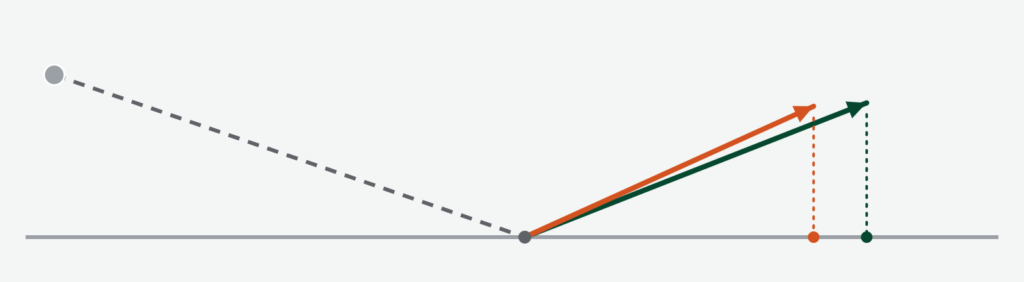
Two properties of the bounce decide a court’s pace. The ITF’s guide to its test methods explains that “A rougher surface has a greater COF, causing a greater reduction in the horizontal velocity and the surface to play ‘slower'”, and that “A surface that yields a higher COR is typically perceived to play slower, because the player has more time to reach the ball.” COF is the coefficient of friction between ball and court. COR is the share of its vertical speed the ball keeps, which decides how high it bounces. To measure both, the ITF’s test fires a ball at the surface at about 16 degrees and 30 m/s.
Clay scores high on both. The physicist Rod Cross notes that “The COF on a fast grass court is about 0.6 while the COF on a clay court is typically about 0.8”, and estimates that a ball can bounce up to twice as high off clay as off grass. In his measurements, a ball arriving at 16 degrees kept 68% of its forward speed on an outdoor acrylic court but only 57% on clay. He also noted that “An exception is a clay court which remains slow at all angles of incidence.”
Match data from professional tennis show the result. Hawk-Eye measurements from tour events found that the ball arrived at almost the same angle on every surface, about 19 degrees, but left the court differently: at 21.41 degrees and 15.94 m/s on grass, and at 24.34 degrees and 13.76 m/s in women’s matches on clay. Across the bounce itself, the ball lost on average 6.52 m/s on grass, 6.69 m/s on an indoor hard court and about 7 m/s on clay. On clay the ball comes off the court steeper and slower.
Longer points, more work
A slower, higher ball gives the defending player more time, so points last longer. At the Grand Slams of 1997 to 1999, average rallies lasted 7.7 seconds at the French Open, against 6.3 at the Australian Open, 5.8 at the US Open and 4.3 at Wimbledon. In women’s Grand Slam matches in 2019, “The effectiveness of the first service was 62.4% on clay, 64.2% on grass and 67.5% on hard court.” In men’s singles, Roland Garros matches involved more hitting than Australian Open matches, “despite a similar number of points played.”
The clearest comparison comes from a study that followed the same six high-level players on both surfaces. On clay, “Mean duration of rallies (8.5 ± 0.2 vs. 5.9 ± 0.5 seconds) and EPT (26.2 ± 1.9 vs. 19.5 ± 2.0%) were significantly longer”, where EPT is effective playing time, the share of the match when the ball is in play. Mean heart rate was 154 beats per minute on clay against 141 on the hard court, and blood lactate 5.7 against 3.6 mmol per litre. The authors concluded that “The court surface should be a key factor for consideration when coaches determine specific training programs for high-level tennis players.”
Hard courts are not all alike, though. In the Hawk-Eye analysis above, the number of racket and surface impacts per game at an indoor hard-court event did not differ from Roland Garros; only grass had fewer. “Hard court” covers a range of speeds, so every comparison depends on which hard court is meant.
Learning to move on clay
Clay also changes how players move. Cross describes it as “doubly unusual” in that “the small particles on the surface behave like ball bearings under a player’s feet, allowing the player to slide more easily than on a hard surface. The coefficient of sliding friction is therefore quite low underfoot and quite high under the ball.”
Players use their legs differently as a result. In a laboratory comparison, “Less knee flexion facilitates sliding on clay, whereas greater knee flexion contributes to braking on the hard court.” Experience matters too: “Players with prior clay court experience exhibited later peak knee flexion compared to those with low experience.” Sliding into a ball and recovering from the slide is a skill that has to be learned, and a player who has only played on hard courts has not yet had the chance to learn it.
Is clay easier on the body?
Clay has a reputation as the gentler surface. The evidence is mixed. A study of Dutch recreational players found that “There is no significant difference in the overall prevalence of injury on clay, hard court, sand-fill artificial grass and red-sand-fill artificial grass”, although lower limb overuse injuries were more common when playing on hard courts. On the professional tours, an analysis of retirements found that for men the risk of retiring from a match was 1.32 times higher on clay and 1.25 times higher on hard courts than on grass.
A laboratory study on synthetic clay found “Lower loading rates and greater sliding distances when clay surface friction was reduced”, which its authors suggest spreads the load and lowers injury risk, but it measured forces, not injuries. Another study found that when playing time was matched, “the ground surface properties influence neither the extent nor the origin of neuromuscular fatigue in tennis.” Clay’s extra physical cost seems to come mainly from longer points and longer matches.
Using clay in a player’s development
The evidence here describes what clay asks of a player. It does not show that growing up on clay produces better players; that would need studies that follow players through their careers. It does suggest how clay can be used:
- Use blocks of clay-court training to work on building points. Longer rallies and a smaller serve advantage reward patience and placement.
- Teach sliding deliberately, as a movement skill with its own progressions, rather than expecting it to appear.
- Prepare players for a higher, slower ball: earlier preparation, and a choice between moving back and taking the ball on the rise.
- Plan the physical load. Rally length, heart rate and lactate were all higher on clay in the same players.
- Check the ball. Under the ITF rules, “Ball Type 1 (fast speed) is intended for play on slow pace court surfaces”.
The evidence describes demands rather than destinies. Clay gives the long rally, the extra ball, the slide and the recovery more time to show, and regular time on it lets a hard-court player find out which of those skills are still missing.
Sources
- International Tennis Federation (2026). ITF Rules of Tennis 2026, Appendix I: Classification of Court Pace. itftennis.com
- International Tennis Federation (2025). ITF approved tennis balls, classified surfaces and recognised courts 2025: a guide to products and test methods. world.tennis
- Cross (2003). Measurements of the horizontal and vertical speeds of tennis courts. Sports Engineering, 6(2), 95-111. doi.org/10.1007/BF02903531
- Cross (2008). Tennis physics, anyone? Physics Today, 61(9), 84-85. doi.org/10.1063/1.2982133
- Lane, Sherratt, Hu and Harland (2017). Characterisation of ball degradation events in professional tennis. Sports Engineering, 20(3), 185-197. doi.org/10.1007/s12283-017-0228-z
- O’Donoghue and Ingram (2001). A notational analysis of elite tennis strategy. Journal of Sports Sciences, 19(2), 107-115. doi.org/10.1080/026404101300036299
- Prieto-Lage, Paramés-González, Argibay-González, Reguera-López-de-la-Osa, Ordóñez-Álvarez and Gutiérrez-Santiago (2022). Match analysis in women’s tennis on clay, grass and hard courts. International Journal of Environmental Research and Public Health, 19(13), 7955. doi.org/10.3390/ijerph19137955
- Brich, Casals and Baiget (2026). Hitting volume demands during men’s Australian Open and Roland Garros: effects of tournament, competition phase, and player level. Sports Health, published online 8 October 2026. doi.org/10.1177/19417381261490005
- Martin, Thevenet, Zouhal, Mornet, Delès, Crestel, Ben Abderrahman and Prioux (2011). Effects of playing surface (hard and clay courts) on heart rate and blood lactate during tennis matches played by high-level players. Journal of Strength and Conditioning Research, 25(1), 163-170. doi.org/10.1519/JSC.0b013e3181fb459b
- Damm, Low, Richardson, Clarke, Carré and Dixon (2013). The effects of surface traction characteristics on frictional demand and kinematics in tennis. Sports Biomechanics, 12(4), 389-402. doi.org/10.1080/14763141.2013.784799
- Starbuck, Damm, Clarke, Carré, Capel-Davis, Miller, Stiles and Dixon (2016). The influence of tennis court surfaces on player perceptions and biomechanical response. Journal of Sports Sciences, 34(17), 1627-1636. doi.org/10.1080/02640414.2015.1127988
- Starbuck, Stiles, Urà, Carré and Dixon (2017). Biomechanical responses to changes in friction on a clay court surface. Journal of Science and Medicine in Sport, 20(5), 459-463. doi.org/10.1016/j.jsams.2016.08.019
- Pluim, Clarsen and Verhagen (2018). Injury rates in recreational tennis players do not differ between different playing surfaces. British Journal of Sports Medicine, 52(9), 611-615. doi.org/10.1136/bjsports-2016-097050
- Oliver, Baiget, Cortés, Martínez, Crespo and Casals (2024). Retirements of professional tennis players in ATP and WTA tour events. European Journal of Sport Science, 24(10), 1526-1536. doi.org/10.1002/ejsc.12177
- Fabre, Martin, Gondin, Cottin and Grelot (2012). Effect of playing surface properties on neuromuscular fatigue in tennis. Medicine and Science in Sports and Exercise, 44(11), 2182-2189. PubMed