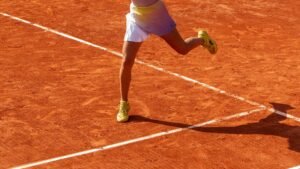

It is three in the afternoon in July. The court has no shade, the air feels thick, and between points the player stands a little longer at the back fence than in the first set. Nothing dramatic is happening yet, and that is the stage at which heat is easiest to manage.
Heat is not only a matter of comfort. Professional tennis now has formal rules for it, research has measured what it does to players, and the medical guidance on when it becomes dangerous is clear. Much of it is useful well beyond the professional tours.
What the rules say
The professional tours do not use air temperature to decide when heat is a problem. They use the Wet Bulb Globe Temperature, or WBGT, a heat stress index. Under the 2026 WTA rulebook, the extreme weather rules apply “when the Heat Stress Index (WBGT) meets or exceeds 30.1 degrees Celsius/86.2 degrees Fahrenheit”. Then “A 10-minute break will be allowed between the second and third sets if either player requests such a break”, and “fans and ice towels are required to reduce players’ body temperature”. Play is suspended when the WBGT “meets or exceeds 32.2 degrees Celsius”.
The ATP introduced the same thresholds from 2026 for “best-of-three singles matches”: cooling measures from a WBGT of 30.1°C during the first two sets, a 10-minute cooling break after the second set that either player may request, and suspension of play “when the WBGT exceeds 32.2°C”. During the ATP break, players “may utilise cooling measures, hydrate, change clothing, shower and receive coaching”.
Junior tennis follows suit. The ITF’s 2026 regulations for its junior tour use the same 30.1°C and 32.2°C triggers and allow the Supervisor to “delay the starting time for matches”. They add one difference that matters to coaches: during the 10-minute break, “No coaching is allowed.” The Australian Open runs its own scale from one to five, built from “air temperature, radiant heat or the strength of the sun, humidity and wind speed”, with “five the suspension of play”, and the referee can close the roof.
What heat does to a player
When 12 men played matches in two conditions, one at about 34°C WBGT and one at about 19°C, rectal temperature at the end of the match reached about 39.4°C in the heat against 38.7°C in the cool, and 6 of the 12 players finished above 39.5°C. They also slowed down: the time between points was about 10 seconds longer in the heat.
Slowing down is a sensible response. In an analysis of 94 matches played between 14.5°C and 38.4°C, “Point duration and effective playing time were reduced when conditions were rated increasingly difficult”. At the Australian Open, a study of 360 matches found that on-court calls for the doctor rose by 47% with each step up in heat stress, but that “few matchplay characteristics were noticeably affected”: there were fewer net approaches and more aces in hotter conditions.
The picture is of players who protect themselves by pacing while their bodies carry more strain. Heat changes the strain more than the tennis, and the danger lies in the strain.
Drinking to a plan
Sweat losses in tennis can be large. A practical review notes that “Tennis players can sweat more than 2.5 L·h-1 and replace fluids at a slower rate during matches than in practice.” It recommends that players “drink more than 400ml every changeover in hot and humid conditions (>27°C WBGT)”, and it suggests a simple way to learn an individual player’s sweat loss: weigh them before a session and subtract their weight afterwards. It also points out that “Sodium (Na+) depletion, not potassium (K+), is a key electrolyte in tennis related muscle cramps.”
When drinks are freely available, dehydration during a match can stay modest. In a related study by the heat research group above, body mass losses of about 0.3%, fluid intake of about 2 litres an hour and sweat rates of about 1.6 litres an hour were similar between conditions. The bigger concern in those matches was the rise in core temperature.
Starting well hydrated matters, especially for juniors. At a national boys’ 14s championship played at a WBGT of about 29.6°C, a urine test of hydration taken before singles was “strongly associated (r = 0.87; p = 0.005)” with each player’s final core temperature. The authors warned that “Junior tennis players who begin a match not well hydrated could have progressively increasing thermal strain … and a greater risk for exertional heat illness as the match advances.” The study was small, eight boys, and all their singles matches were “fairly easy straight sets wins”.

Cooling at the changeover
Cooling between games works, and it need not be expensive. In laboratory conditions modelled on the Australian Open, at 45°C with very low humidity and strong sun, both the currently recommended ice intervention and an alternative strategy reduced rectal temperature by about 0.5 to 0.6°C and skin temperature by about 1.0 to 1.5°C. The authors added a warning: “Fan use must be used with skin wetting to be effective in hot/dry conditions.”
In hot and humid conditions, at 36°C and 50% relative humidity, a related study found that a fan combined with wetting the skin was “an equally effective alternative that may be more practical in limited resource settings.” For a club, that means a spray bottle and a fan can do much of what an ice chest does, as long as the skin is kept wet.
Acclimatise first
The most useful step happens before the tournament. An international consensus statement is direct: “The most important intervention one can adopt to reduce physiological strain and optimise performance is to heat acclimatise.” It recommends “repeated exercise-heat exposures over 1-2 weeks”, with sessions lasting “at least 60 min/day”. A position statement from athletic trainers in the United States gives a similar window: “Individuals should be acclimatized to the heat gradually over 7 to 14 days.”
When heat becomes an emergency
Heat exhaustion and heat stroke are different conditions. The NHS lists the signs of heat exhaustion as including tiredness, dizziness, headache, cramps in the arms, legs and stomach, and being very thirsty, and says it “does not usually need emergency medical help if you can cool down within 30 minutes”. It advises calling emergency services if someone is still unwell after 30 minutes of resting in a cool place, being cooled and drinking fluids, or if they have hot skin that is not sweating, confusion and lack of coordination, or lose consciousness.
Exertional heat stroke is “a true medical emergency with potential for organ injury and death.” Its two main diagnostic criteria are “CNS dysfunction and a core body temperature greater than 40.5°C (105°F)”, in other words confusion or other changes in behaviour together with a very high core temperature. The guidance on treatment is clear: “Cold-water immersion up to the neck is the most effective cooling modality”, and when medical staff are on site, patients “should be cooled first and transported second.” A forehead or ear thermometer cannot rule heat stroke out; the same statement says “Rectal temperature thermometry is the only method of obtaining an immediate and accurate measurement”.
A heat plan for match day
- Know the event’s heat rules: the WBGT triggers, whether a break is allowed, and whether coaching is allowed during it.
- Arrive acclimatised, with one to two weeks of training in the heat beforehand.
- Start the match well hydrated, drink to a plan at every changeover and include sodium.
- Learn each player’s sweat loss by weighing them before and after practice.
- Cool at changeovers with iced towels or a fan with wet skin, and never rely on a dry fan in dry heat.
- Treat confusion in a hot player as an emergency: cool first and call for help.
Heat changes the risk more than it changes the tennis. Players who arrive acclimatised and keep drinking and cooling can still play their game on a hot afternoon, and coaches and parents who know the warning signs can make sure a hard match does not turn into a medical one.
Sources
- WTA (2026). 2026 Official Rulebook, Section XVIII.B, item 6: Extreme Weather Conditions and Lightning. wtatennis.com
- ATP Staff (2025). New heat rule effective from 2026. ATP Tour, 15 December 2025. atptour.com
- International Tennis Federation (2025). ITF World Tennis Tour Juniors 2026 Regulations, Appendix D. world.tennis
- Tennis Australia (2018). AO Heat Stress Scale a Grand Slam first. ausopen.com, 27 December 2018. ausopen.com
- Périard, Racinais, Knez, Herrera, Christian and Girard (2014). Thermal, physiological and perceptual strain mediate alterations in match-play tennis under heat stress. British Journal of Sports Medicine, 48(Suppl 1), i32-i38. doi.org/10.1136/bjsports-2013-093063
- Morante and Brotherhood (2008). Autonomic and behavioural thermoregulation in tennis. British Journal of Sports Medicine, 42(8), 679-685. doi.org/10.1136/bjsm.2007.042499
- Smith, Reid, Kovalchik, Woods and Duffield (2018). Heat stress incident prevalence and tennis matchplay performance at the Australian Open. Journal of Science and Medicine in Sport, 21(5), 467-472. doi.org/10.1016/j.jsams.2017.08.019
- Kovacs (2006). Hydration and temperature in tennis: a practical review. Journal of Sports Science and Medicine, 5(1), 1-9. jssm.org
- Périard, Racinais, Knez, Herrera, Christian and Girard (2014). Coping with heat stress during match-play tennis: does an individualised hydration regimen enhance performance and recovery? British Journal of Sports Medicine, 48(Suppl 1), i64-i70. doi.org/10.1136/bjsports-2013-093242
- Bergeron, McLeod and Coyle (2007). Core body temperature during competition in the heat: National Boys’ 14s Junior Championships. British Journal of Sports Medicine, 41(11), 779-783. doi.org/10.1136/bjsm.2007.036905
- Lynch, Périard, Pluim, Brotherhood and Jay (2018). Optimal cooling strategies for players in Australian Tennis Open conditions. Journal of Science and Medicine in Sport, 21(3), 232-237. doi.org/10.1016/j.jsams.2017.05.017
- Schranner, Scherer, Lynch, Korder, Brotherhood, Pluim, Périard and Jay (2017). In-play cooling interventions for simulated match-play tennis in hot/humid conditions. Medicine and Science in Sports and Exercise, 49(5), 991-998. doi.org/10.1249/MSS.0000000000001183
- Racinais, Alonso, Coutts, Flouris, Girard, González-Alonso and others (2015). Consensus recommendations on training and competing in the heat. British Journal of Sports Medicine, 49(18), 1164-1173. doi.org/10.1136/bjsports-2015-094915
- Casa, DeMartini, Bergeron, Csillan, Eichner, Lopez and others (2015). National Athletic Trainers’ Association position statement: exertional heat illnesses. Journal of Athletic Training, 50(9), 986-1000. doi.org/10.4085/1062-6050-50.9.07
- Roberts, Armstrong, Sawka, Yeargin, Heled and O’Connor (2023). ACSM expert consensus statement on exertional heat illness: recognition, management, and return to activity. Current Sports Medicine Reports, 22(4), 134-149. PubMed
- NHS. Heat exhaustion and heatstroke (page last reviewed 28 May 2026). nhs.uk