

In 2024, about one in ten of Aryna Sabalenka’s backhands was a slice. In 2025 it was around 15 per cent. In 2026, according to Tennis Australia’s analysts, the sliced backhand is a shot “she now opts for on nearly 20 per cent of all backhands”, which they describe as “by far the highest proportion among top women.”
She is not alone at the top. The same analysis found that in 2025 Novak Djokovic and Carlos Alcaraz sliced more than 20 per cent of their backhands, “the highest proportion among the then-top five”, and that this is “a percentage Alcaraz has maintained in 2026”.
So is the slice back? For some of the best players in the world, the numbers say yes. For the game as a whole the picture is less clear, and the data on what the slice actually wins are more sobering than its admirers might like.
How much slice the professionals hit
The only official tour-wide figure is recent. Using Hawk-Eye data from ATP matches, the tour’s own analysts reported that “The Tour average is 21 per cent backhand slice in 2024.” That puts Djokovic and Alcaraz, at a little over 20 per cent in 2025, roughly at the tour average rather than above it. The figures come from different data sets, so the comparison is rough, but it suggests the top men are not slicing much more than everyone else.
The average also hides a wide spread. Analysing charted matches from 2010 to 2019, Jeff Sackmann found that “men, on average, hit more slices, largely because a small number of men hit a lot of slices,” and that “Women are much more likely than men to hit a non-slice backhand from their backhand corner.” Lorenzo Musetti, one of that small number, sliced 39.4% of his backhands in Sackmann’s charting data.
On the return, the split between one-handed and two-handed players is stark. In 650 charted men’s matches, one-handers used the slice on 53.9% of backhand returns against first serves and 32.3% against second serves. Two-handers used it on 20.5% of returns against first serves and only 2.5% against second serves.
None of these figures makes a trend. They come from different sources and different years, so they show how the slice is used today rather than proving a comeback across the tour.
What the slice wins, and what it does not
As an approach shot, the slice has a poor record. In more than 84,000 data points from charted men’s matches since 2020, players won 71.8% of points when they approached off the forehand but “barely half (50.4%) of backhand-slice approaches.” Women won 68% of forehand approaches, 66.2% of topspin backhand approaches and 45.6% of slice backhand approaches. Players seem to have noticed: “Barely one in five backhand-side approaches are slices, as players tire of watching passing shots sail by.”
Grass helps a little. “On grass, men’s slice approaches end up winning the point 53.6% of the time,” while for women, “slice approaches have the same outcomes on grass as elsewhere.”
Returns tell a similar story. Sackmann’s analysis of men’s matches found that, on average, “slice returns are less effective than flat or topspin backhand returns”, with one exception the post points out: slice returns by one-handed players against second serves.
These numbers need one caution. The data do not control for where the player was standing or how good the previous shot was, and Sackmann suggests part of the gap “probably stems from net-rushing in suboptimal circumstances”. A player who slices because they have been pulled wide was already in trouble, so some of the slice’s poor record may reflect the situations in which it is played rather than the shot itself.
What backspin does to the ball
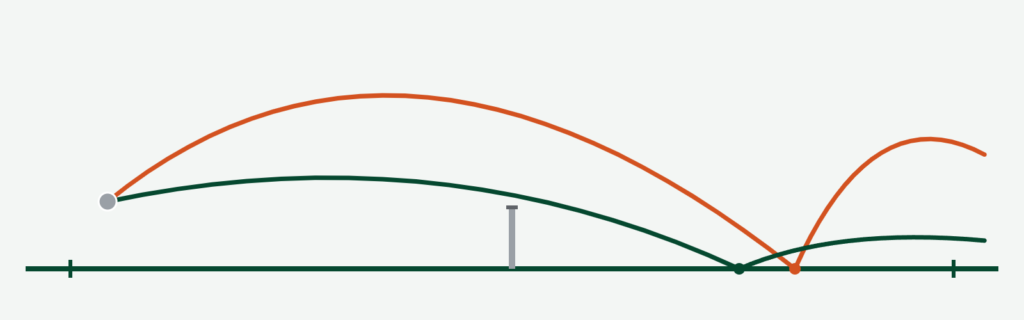
The physics explains why the slice is useful and also why it is easy to overrate. In the air, backspin produces lift. In measurements of balls in flight with topspin or backspin up to 2,500 rpm, “The lift coefficient increased with ball spin, on average”, and as the physicist Rod Cross puts it in a note on ball aerodynamics, “A ball launched with backspin will fall more slowly to the ground than a ball launched without spin”. The slice flies flatter and floats, while topspin dips.
At the bounce, backspin makes the ball slide: “If the ball is hit with backspin or the surface is slippery, the ball will slide throughout the duration of the bounce for a larger range of incident angles.” Sliding friction takes away horizontal speed, and how much depends on the court. Cross gives the grass at Wimbledon a coefficient of sliding friction of 0.5-0.6, “the fastest surface used in a Grand Slam event”, while on clay it “can be as high as 0.9 at low angles of incidence”. The ITF’s guide to court testing says the same in general terms: “A rougher surface has a greater COF, causing a greater reduction in the horizontal velocity and the surface to play ‘slower’.”
That rules out a popular idea. A slice does not speed up off the court. It loses less speed on grass than on clay, which helps explain why it works better on grass, but friction still slows it. Topspin behaves differently. In one experiment, as topspin increased, “The ratio of the rebound to the incident horizontal speed increased from 0.5 to 0.95”. Cross drew a wider lesson from that result: “The classification or perception of a tennis court as being fast or slow is therefore of limited value, given that most players strike the ball with topspin.” The official court pace test, for its part, assumes a ball that arrives “with negligible spin”.
The slice also stays low. Lift flattens its flight, so it lands at a shallower angle, and a doctoral study of ball impacts found that “impacts with backspin caused more deformation and an increased energy loss compared to normal impacts with the same vertical velocity”, while “Impacts with topspin had a reduced vertical energy loss.” A ball that stays below the height of the net after the bounce makes the opponent hit up.
Where the slice still works
None of this makes the slice a bad shot. It makes it a specific one. A review of research on the backhand concluded that “Players using a two-handed backhand should learn early a slice one-handed backhand”, and the professional data show where it is used most: against first serves, when the returner has the least time, and by players who choose it often.
- Teach the slice early, including to two-handed juniors, as the review recommends.
- Use it first as a defensive shot, especially on returns against big first serves.
- Be careful with it as an approach. On average it loses, and even on grass men win only 53.6% of slice approaches.
- Keep it low. Across all shots in Australian Open tracking data, “shots in the highest speed and lowest net clearance categories tended to be the most effective”, and a slice that floats high gives away its main advantage.
- Think about the surface. The slice slides most on low-friction courts such as grass and is slowed most on clay.
So the slice is back, at least at the very top: Sabalenka, Djokovic and Alcaraz all use it often. What club players and juniors can take from them is the intent rather than the percentage. A slice that is low, chosen and well placed is a useful shot at any level. A slice hit only to avoid hitting a backhand is much closer to the shot the averages describe.
Sources
- Trollope (2026). Backhand analysis: go down the line, reap rewards. Australian Open, 27 October 2026. ausopen.com
- O’Shannessy (2024). Backhand abundance: Medvedev’s knuckleball in an era of fastballs. ATP Tour, 27 September 2024. atptour.com
- Sackmann (2019). A first look at the down-the-line backhand. Tennis Abstract, 13 December 2019. tennisabstract.com
- Sackmann (2025). Lorenzo Musetti and the one hand to rule them all. Tennis Abstract, 15 April 2025. tennisabstract.com
- Sackmann (2015). Measuring the effectiveness of backhand returns. Tennis Abstract, 22 October 2015. tennisabstract.com
- Sackmann (2026). Where should you hit an approach shot? Tennis Abstract, 15 October 2026. tennisabstract.com
- Cross and Lindsey (2014). Measurements of drag and lift on tennis balls in flight. Sports Engineering, 17(2), 89-96. doi.org/10.1007/s12283-013-0144-9
- Cross (undated). Sports ball aerodynamics. University of Sydney. usyd.edu.au
- Cross (2008). Tennis physics, anyone? Physics Today, 61(9), 84-85. doi.org/10.1063/1.2982133
- International Tennis Federation (2025). ITF approved tennis balls, classified surfaces and recognised courts: a guide to products and test methods. world.tennis
- Cross (2019). Effect of topspin on the apparent speed of a tennis court. Sports Engineering, 22(1), 5. doi.org/10.1007/s12283-019-0296-3
- Dignall (2005). Modelling the impact of tennis balls on court surfaces. PhD thesis, University of Sheffield. whiterose.ac.uk
- Genevois, Reid, Rogowski and Crespo (2015). Performance factors related to the different tennis backhand groundstrokes: a review. Journal of Sports Science and Medicine, 14(1), 194-202. jssm.org
- Kovalchik and Reid (2018). A shot taxonomy in the era of tracking data in professional tennis. Journal of Sports Sciences, 36(18), 2096-2104. PubMed