
Open a new can of tennis balls and it hisses. The can is pressurised for a reason: as the physicist Rod Cross explains, “Pressurized balls are usually packaged in a pressurized can to prevent gradual leaking of the air through the ball.” Most players never think further about the ball than the brand on the can. The Rules of Tennis think about it a great deal.
What the rules define
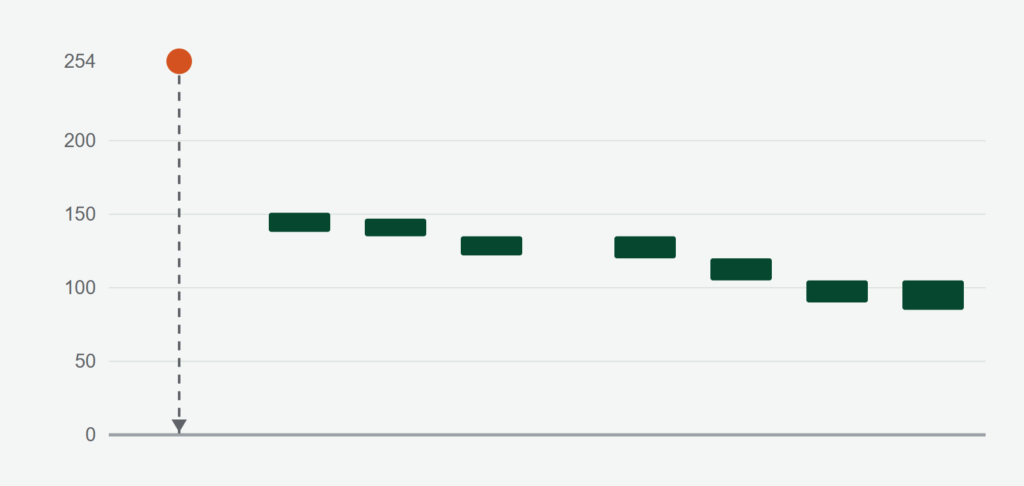
The ITF’s Rules of Tennis describe eight kinds of ball, each with its own limits for size, mass and bounce, and most with limits on how much they squash under load. Bounce is measured in a simple way: “The ball is dropped from a height of 254 ± 0.3 cm (100 ± 0.1 inches)” onto a smooth, rigid block, and the rebound height is measured. The size and bounce windows for each ball, from Appendix I of the 2026 rules, are:
| Ball | Size (cm) | Bounce (cm) |
|---|---|---|
| Type 1 (fast) | 6.54-6.86 | 138-151 |
| Type 2 (medium) | 6.54-6.86 | 135-147 |
| Type 3 (slow) | 7.00-7.30 | 135-147 |
| High altitude | 6.54-6.86 | 122-135 |
| Stage 1 green | 6.30-6.86 | 120-135 |
| Stage 2 orange | 6.00-6.86 | 105-120 |
| Stage 3 red | 7.00-8.00 | 90-105 |
| Stage 3 red foam | 8.00-9.00 | 85-105 |
Mass follows the same pattern. Types 1, 2 and 3 and the high-altitude ball must weigh 56.0 to 59.4 g, while the stage balls are lighter: 47.0 to 51.5 g for green, 36.0 to 46.9 g for orange and as little as 25.0 g for a red foam ball.
The names can mislead. A “fast” ball is meant for slow courts: the rules state that “Ball Type 1 (fast speed) is intended for play on slow pace court surfaces” and “Ball Type 3 (slow speed) is intended for play on fast pace court surfaces”. The larger Type 3 ball slows the game down on a fast court, and the livelier Type 1 speeds it up on clay. An ITF paper from 2019 described Type 1 as “a slightly harder, faster ball”, but in the current table its main difference from Type 2 is a higher bounce window.
Every number in the table assumes standard conditions. The ITF tests balls at about 20°C, 60% relative humidity and normal sea-level pressure, because “the properties of the rubber core and its internal gas are affected by temperature, the properties of the cover by atmospheric moisture, and the effective internal pressure by the external atmospheric pressure”. In the ITF’s own words elsewhere, “High humidity can increase the mass of the ball”, and high temperatures can affect the rubber and increase the bounce. A ball on a hot afternoon, or on a damp morning, is not quite the ball that was tested.
Pressurised and pressureless
Pressurised balls are the ones sold in pressurised cans. The ITF puts their internal pressure at “typically at 10-13 psi above atmospheric pressure”, Cross at “typically 6-12 psi”, while the air inside a pressureless ball is at atmospheric pressure. The two designs get their bounce from different places: “The elasticity (bounce) of a pressurised ball is derived from its internal pressure to a greater extent than the pressureless ball, the latter of which derives a greater amount of its bounce from the rubber core, which is necessarily thicker.”
Losing that pressure changes a ball at once. Cross found that “A depressurized ball is noticeably softer and has a lower coefficient of restitution, immediately on release of the air.” In tests with rackets, “Pressurized balls had the highest coefficient of restitution, which decreased by 20% when punctured”, and “Pressureless balls had a coefficient of restitution approaching that of a punctured ball at high speeds.”
Pressureless balls are not only for practice. The rules allow a pressureless Type 2 ball with an internal pressure “no greater than 7 kPa (1 psi)”, and say it “may be used for high altitude play above 1,219 m (4,000 feet) above sea level” once it has been acclimatised there for 60 days or more.
How a ball changes in play
At the Grand Slams, “Six (6) balls are to be provided for each Main Draw match and are to be changed after the first seven (7) and thereafter every nine (9) games”, and “The cans with new balls should be opened just before the match/ball change.” The ITF’s durability test reflects the same span: it uses laboratory equipment “to simulate the effects of nine games of play.”
Nine games is a lot of work for a ball. Hawk-Eye data from professional matches found that on hard and clay courts each ball took between 105.5 and 107.3 impacts during nine games, about 52 of them with the court and 40 with rackets; on grass the figure was 81.7. “Mass reduction is dominated by a loss of felt and has been shown to increase with both impact speed and number of impacts.” The ITF adds that “In general, balls soften (deformation increases) and weigh less after they have been used. However, the mass of a ball used on clay often does not change because particles of clay stick to the cloth.”
Some of the effects of wear run against intuition. The same Hawk-Eye paper notes that in earlier testing, “Used balls exhibited increased bounce height, mass reduction and reduced stiffness.” A ball that feels dead is softer, but it does not necessarily bounce lower. In the air, a study of men’s first serves using Hawk-Eye data found that “the mean Cd value of new balls was 0.579 and the mean Cd value of used balls was significantly higher at 0.603”, so used balls met more air resistance, and “The new balls reached the court 0.0074 s sooner than used balls”. The authors suggest that “the felt of a used ball is raised and not worn down”, although they also note that the common view had been the opposite, so this is one study rather than a settled answer.
Balls also age on the shelf. The ITF’s approval procedures exclude balls made more than 12 months before a test from one kind of assessment “due to the effects of ball ageing”.
The ball as a coaching tool
Because the ball changes the game, choosing it is a coaching decision. When 20 elite juniors played with a ball at 75% of normal compression, “the modified ball increased rally speed, allowed players to strike the ball at a lower (more comfortable) height on their groundstrokes and increased the number of balls played at the net.” In a study of eight players, “The mean time to volitional fatigue was 29.5% greater during the Type 3 trials than during the Type 2 trials”. The green, orange and red balls in the table apply the same idea to children: a slower ball with a lower bounce for smaller players.
A few practical points follow from all this:
- Match the ball to the court: Type 1 for slow courts such as clay, Type 3 for fast courts, Type 2 in between.
- At altitude, use high-altitude balls or acclimatised pressureless Type 2 balls, as the rules allow.
- For matches, open the can just before play, as the Grand Slams do.
- Expect heat and humidity to change how a ball plays, even within the same can.
- In training, treat ball type as a choice: a lower-compression ball changes contact height, rally speed and net play.
A tennis ball looks like the simplest piece of equipment in the game. It comes in eight officially defined kinds, the pressurised versions slowly leak the air that gives them their bounce, and in professional tennis a ball is replaced every nine games. Paying attention to which ball is in play costs nothing, and it explains more about how a court feels than most players expect.
Sources
- International Tennis Federation (2026). ITF Rules of Tennis 2026, Rule 3 and Appendix I. itftennis.com
- International Tennis Federation (2025). ITF approved tennis balls, classified surfaces and recognised courts 2025: a guide to products and test methods. world.tennis
- International Tennis Federation (2019). Balls. ITF Technical Centre. world.tennis
- International Tennis Federation (2019). Ball approval tests. ITF Technical Centre. world.tennis
- International Tennis Federation (2025). Procedures for obtaining 2026 ITF approval of tennis balls. world.tennis
- Grand Slam Tennis (2026). 2026 Official Grand Slam Rule Book, Article I. world.tennis
- Cross (1999). Dynamic properties of tennis balls. Sports Engineering, 2, 23-33. usyd.edu.au
- Haake, Carré and Goodwill (2003). The dynamic impact characteristics of tennis balls with tennis rackets. Journal of Sports Sciences, 21(10), 839-850. doi.org/10.1080/0264041031000140329
- Lane, Sherratt, Hu and Harland (2017). Characterisation of ball degradation events in professional tennis. Sports Engineering, 20(3), 185-197. doi.org/10.1007/s12283-017-0228-z
- Choppin, Albrecht, Spurr and Capel-Davies (2018). The effect of ball wear on ball aerodynamics: an investigation using Hawk-Eye data. Proceedings, 2(6), 265. doi.org/10.3390/proceedings2060265
- Kachel, Buszard and Reid (2015). The effect of ball compression on the match-play characteristics of elite junior tennis players. Journal of Sports Sciences, 33(3), 320-326. doi.org/10.1080/02640414.2014.942683
- Cooke and Davey (2005). Tennis ball diameter: the effect on performance and the concurrent physiological responses. Journal of Sports Sciences, 23(1), 31-39. doi.org/10.1080/02640410410001730052