
Next time you watch a professional match, try a small experiment. For one game, do not follow the ball. Watch the returner as the server tosses: where they stand, when they hop, which way they lean. Then watch the server after the point ends: how quickly they walk back, what they do with the towel, how long they take before the next serve. The ball will still be there in the next game, and you will have seen a different match.
A coach’s eye goes to what the ball does not show: the feet, the body, the pauses and the score. A few findings from match analysis and from research on expertise make that easier, and they work as well from a sofa as from a seat in the stadium.
Count the shots
Most professional points are short. In an analysis of 4,669 points from the men’s singles at three Grand Slams in 2021, from the quarter-finals onwards, points of up to four shots made up 64.9% of points on clay, 77.4% on grass and 68.8% on hard courts. When the first serve went in and the rally stayed short, the server won about 80% of the points.
The surface matters too. On grass, more than three points in four were over within four shots; on clay, the share was closer to two in three. Watching a clay-court match, expect more of it to be decided in the rallies, and on grass expect the first few shots to carry even more weight.
Those figures come from one season and a fairly small number of matches, and studies count shots in slightly different ways. The pattern is still clear enough to use. Count the shots in each point for a set, in rough groups such as up to four, five to eight and nine or more, and you will soon see whether the match is being decided by the serve and return or in the longer rallies.
Which short points matter
Not all short points are equal. A study of 211 men’s and 209 women’s matches at Wimbledon from 2015 to 2017 counted shots so that a double fault is a zero-shot point and an ace or a missed return is a one-shot point. Winning points of one, two and four shots was associated with winning matches, while winning points of zero or three shots was not.
The second finding is a surprise. Points won with the third shot are the classic “serve plus one” pattern, and the authors note that their results “appear to contravene anecdotal assertions” about the importance of these points in elite tennis, because at Wimbledon “they did not differentiate winning and losing players”. The study shows association rather than cause, and it covers only grass. Still, it suggests watching the return and the exchange that follows it as closely as the serve.
Look at the right place at the right time
Research on expertise gives a viewer some useful hints about where to look. A meta-analysis of 42 studies found that “experts are better than nonexperts in picking up perceptual cues” and that they search differently, “using fewer fixations of longer duration”. In tennis, a study of players preparing to return serve found that during the server’s routine, “experts focus on the shoulder/trunk areas whereas novices concentrate their search around the head of the server”, and that during the swing, “experts concentrate on the racquet”. Experts do not ignore the ball. They look at the right place at the right time.
The returner’s feet are a good place to practise this. A study of world-class returners, including male and female professionals and ITF juniors, found that all groups started the split-step “around the time ball-racket contact in the serve stroke” and “landed when early ball-flight information was available.” Watch the returner instead of the server for a few points and you can see it: a small hop as the server strikes the ball, and a landing just as the direction of the serve becomes clear.
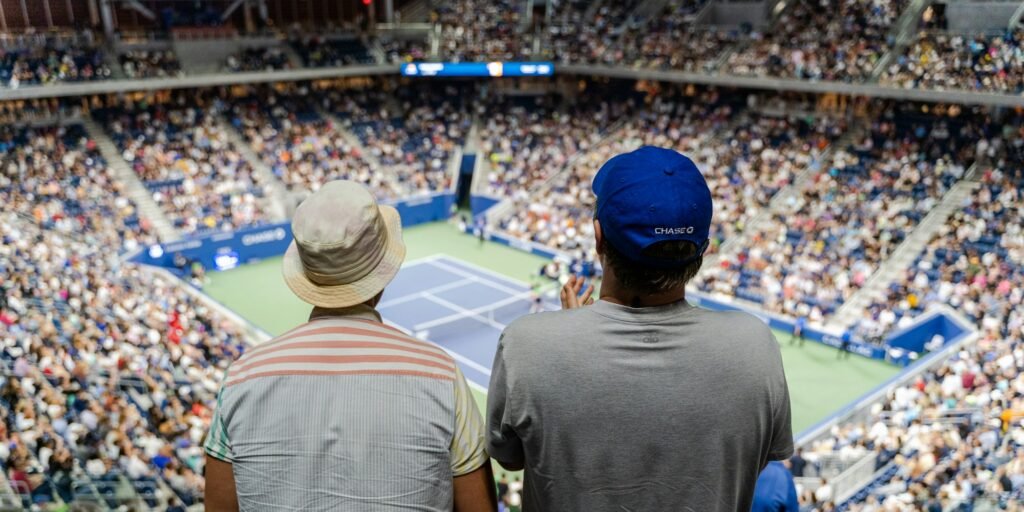
These studies are about players reading opponents, not about spectators, so applying them to watching is an inference. It is a reasonable one. If experts gain by watching the body early and the racket late, a viewer who does the same will see more of the match.
Watch between the points
The time between points is not empty. An analysis of 3475 serves at the 2016 Australian Open found that the time players took between points was influenced by “the serving player, the duration of the previous rally, the service game, the current scoring streak and the importance of the point.” The average was 21.5 seconds, against a limit that was then 20 seconds. Today the Rules of Tennis allow “a maximum of twenty-five (25) seconds”.
So the pauses carry information. Watch what a player does after losing a long rally, after a double fault or at 30-40: whether they slow down or rush, whether the routine stays the same, where they look. A routine that changes under pressure tells you something before the next point starts.
Watch the big points
Professional data suggest that play changes when the stakes rise. In the men’s singles at Wimbledon in 2016, an analysis of 28,570 points compared 1039 tiebreak points with the rest. After a first serve, rallies on tiebreak points were slightly longer, 3.70 shots on average against 3.27, and players made fewer unforced errors, 20.60% against 23.50%. The statistical evidence is weak, but the direction fits other research showing that on more important points players hit closer to the centre of the court and higher over the net.
The ATP’s own statistics give viewers an easy way to follow this. Its leaderboards include an “Under Pressure” rating, shown alongside break points converted and saved, tie-breaks won and deciding sets won, with a filter for the last 52 weeks. The page lists those ingredients but does not show how the rating is calculated, so it is best treated as a summary rather than a precise measurement. Checking those numbers before a match tells you who has handled big moments well recently. The match itself will show you how they do it.
Keep a simple chart
The surest way to watch like a coach is to write things down. Volunteers in the Match Charting Project do this for professional matches, shot by shot; their records include “the type of shot, direction of shot, depth of returns, types of errors, and more”, and in November 2026 the project listed 18,478 charted matches. A home version can be much simpler. For one set, note:
- On each service point, whether the first serve went in and roughly where it went.
- How many shots the point lasted.
- How it ended: a winner, a forced error or an unforced error.
- The score on points that felt important, and what each player did before them.
After one set you will have your own view of how the match is being won, rather than the one the commentary offers. After a few matches you will start to notice patterns before they appear on the scoreboard.
Watching professionals this way is also good practice for watching juniors. The same questions work at any level: how long the points are, which of them are being won, what happens between them, and what changes when the score gets tight.
Sources
- Prieto-Lage, Paramés-González, Torres-Santos, Argibay-González, Reguera-López-de-la-Osa and Gutiérrez-Santiago (2023). Match analysis and probability of winning a point in elite men’s singles tennis. PLoS ONE, 18(9), e0286076. doi.org/10.1371/journal.pone.0286076
- Fitzpatrick, Stone, Choppin and Kelley (2021). Investigating the most important aspect of elite grass court tennis: short points. International Journal of Sports Science and Coaching, 16(5), 1178-1186. doi.org/10.1177/1747954121999593
- Mann, Williams, Ward and Janelle (2007). Perceptual-cognitive expertise in sport: a meta-analysis. Journal of Sport and Exercise Psychology, 29(4), 457-478. doi.org/10.1123/jsep.29.4.457
- Goulet, Bard and Fleury (1989). Expertise differences in preparing to return a tennis serve: a visual information processing approach. Journal of Sport and Exercise Psychology, 11(4), 382-398. doi.org/10.1123/jsep.11.4.382
- Mecheri, Laffaye, Triolet, Leroy, Dicks, Choukou and Benguigui (2019). Relationship between split-step timing and leg stiffness in world-class tennis players when returning fast serves. Journal of Sports Sciences, 37(17), 1962-1971. doi.org/10.1080/02640414.2019.1609392
- Kolbinger, Großmann and Lames (2019). A closer look at the prevalence of time rule violations and the inter-point time in men’s Grand Slam tennis. Journal of Sports Analytics, 5(2), 75-84. doi.org/10.3233/JSA-180277
- International Tennis Federation (2026). ITF Rules of Tennis 2026, Rule 29: Continuous Play. itftennis.com
- Meffert, O’Shannessy, Born, Grambow and Vogt (2019). Tennis at tiebreaks: addressing elite players’ performance for tomorrows’ coaching. German Journal of Exercise and Sport Research, 49(3), 339-344. doi.org/10.1007/s12662-019-00611-3
- Paserman (2023). Gender differences in performance in competitive environments? Evidence from professional tennis players. Journal of Economic Behavior and Organization, 212, 590-609. doi.org/10.1016/j.jebo.2023.05.042
- ATP Tour. Leaderboard (statistics page, accessed 5 November 2026). atptour.com
- Tennis Abstract. Match Charting Project (metadata page, accessed 5 November 2026). tennisabstract.com