
Most coaches know this scene. A junior stands at the baseline next to a full basket and serves forty balls into the same box. The toss settles, the rhythm settles, and by the end most serves land where they should. Player and coach both leave the court feeling that something has improved.
Then the weekend comes. Someone is standing on the other side of the net, the score matters, the serve has to be followed by a ball that comes back, and the rhythm from Tuesday is nowhere to be found. The drill was not useless. It measured something different from what the match asks for, and it gave everyone a confident reading of the wrong thing.
Performance is not learning
The distinction at the heart of this problem has been studied for decades. In their review of the field, Soderstrom and Bjork point out that during training “what we can observe and measure is performance, which is often an unreliable index” of the longer-term changes that make up learning. Worse, people “often mistakenly interpret their performance during acquisition as a reliable guide to long-term learning.”
That sentence describes the basket serve drill rather well. Forty serves in a row produce a run of good performance. Whether they produce a better serve on Saturday is a separate question, and the answer cannot be read off the basket.
What the research on practice order found
The classic study here is more than forty years old. Shea and Morgan had 72 college students learn three motor tasks, either in blocks, one task at a time, or in a random sequence. On later tests, transfer was greater for the groups who had practised in random order, and the effect “was most notable when transfer was measured for the transfer task of greatest complexity.” The finding became known as the contextual interference effect, and it is the reason many coaching courses recommend mixing skills rather than repeating one.
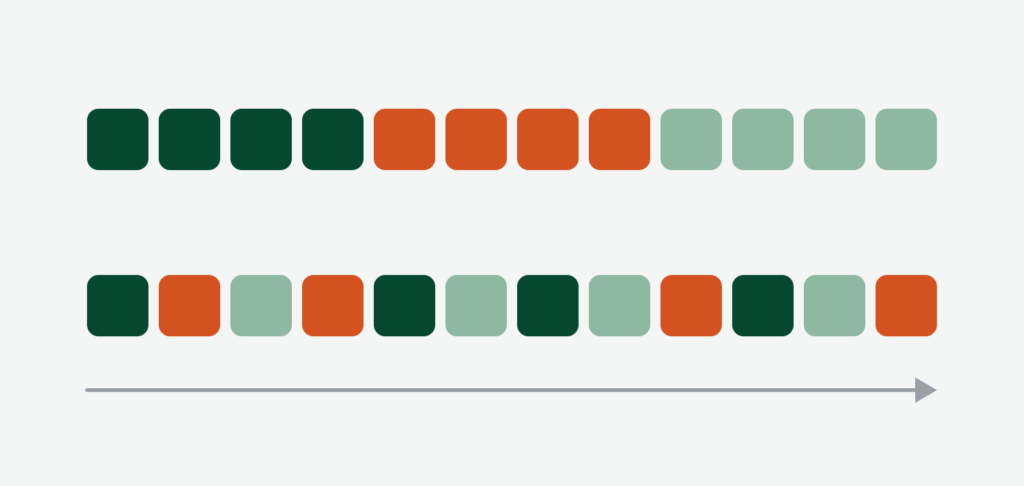
The story is less tidy outside the laboratory. A 2024 meta-analysis of 54 studies found a medium overall benefit for mixed practice on retention, but in applied studies the effect was “slightly above negligible” and not statistically significant. Only three of the 54 articles were judged to be of moderate or high quality. A companion analysis on transfer found the same pattern: in applied studies the effect was small and non-significant. Another 2024 review was blunter still. Of 183 pooled outcomes, only 37, or 20%, matched the textbook pattern, which the authors said calls into question applying the model to physical education and sport.
Age matters too. An earlier meta-analysis reported an effect size of .57 in basic research against .19 in applied research, and .50 for adults against only .10 for younger learners. Shuffling the order of drills is not a magic switch, least of all with children.
What the tennis studies show
Tennis has its own evidence, and it points somewhere more useful than the order of the basket. When researchers recorded the serving drills of nine skilled players, six of the nine “practiced the serve with zero between-skill variability in more than 50% of drills”. In other words, the serve was almost always practised on its own.
In the second part of the same study, 16 players aged 11 to 13 trained for ten sessions. One group hit 40 serves and then 40 groundstrokes; the other alternated the two skills in blocks of four. During practice the two groups were almost identical, hitting the target on 36% and 37% of their serves. In matches afterwards, the group that had alternated served 26.1 cm closer to the T than the other group. The authors are careful to add that the change from pre-test to post-test was not statistically significant for either group, so this is a hint rather than proof. It is still a telling hint: identical practice numbers, different match behaviour.
A wider look at elite juniors found the same habits. Serve and return practice made up less than 13% of total practice time, and each skill was “predominately practised in isolation”. Compared with what the same players did in matches, their practice had fewer serves and returns landing in, less variety in shot choice and fewer serves aimed at the edges of the box. The two shots that start every point were practised little, and in conditions that looked unlike a match.
Ball machines raise a similar question. In a small study comparing returns against a machine and against a real server, players facing the machine had a shorter movement initiation and a longer backswing, and the authors advised limiting machine use because it “may disrupt stroke timing.” It is one small study, and machines have real value; a review of their use notes that they “play a crucial role in reducing injury incidence in players and coaches.” The lesson is narrower: returning a machine is a different timing task from returning a person.
Keep the match in the drill
The idea that ties these findings together is called representative learning design. Krause and colleagues, who built a tool for rating tennis drills with academics and coaches, summarise its premise simply: “when practice replicates the performance environment, skills are more likely to transfer.” Applying the tool, they found that tennis coaches “prioritised tasks low in representativeness.”
The basket serve drill scored lowest of the tasks the experts rated, 39 points, while a “Serve Plus One” drill scored 56. The thesis built around the tool turns this into concrete advice: keep the perception and action of the real shot together, for example by including a returner or requiring a third shot when practising the serve.
There is a caution here as well. When the same group made junior practice more match-like over six weeks, the relationship with skill acquisition “was not linear”, and the thesis adds that the changes in behaviour did not result in players winning more points or hitting more aces. More realism is a direction, not a dial to turn all the way up.
Redesigning a classic drill
None of this means throwing the basket away. Blocked repetition still has a place when a player is changing technique, coming back from injury or simply needs a lot of contacts. The useful question is what the drill leaves out, and the basket serve drill leaves out almost everything a serve has to deal with in a match. A coach can bring it back one piece at a time:
- Put a returner on the other side, so the serve has a reader and the server sees a ball coming back.
- Play out the third shot, because in a match the serve is the first half of a pattern, not the end of it.
- Change targets and boxes in an order the server does not know in advance.
- Alternate serves with other shots in short blocks, four rather than forty.
- Keep score, so that a second serve at 30-40 feels like one.
The drill will look worse at first. Fewer serves will land, rallies will break down and the session will feel messier than the basket ever did. That is exactly what the performance and learning research warns about: the clean session is the one most likely to fool everyone.
A fair test of any drill is to ask what the player will see, decide and feel on match day, and how much of that the drill contains. If the answer is very little, the drill can still be useful. It just should not be the measure of progress.
Sources
- Shea and Morgan (1979). Contextual interference effects on the acquisition, retention, and transfer of a motor skill. Journal of Experimental Psychology: Human Learning and Memory, 5(2), 179-187. doi.org/10.1037/0278-7393.5.2.179
- Soderstrom and Bjork (2015). Learning versus performance: an integrative review. Perspectives on Psychological Science, 10(2), 176-199. PubMed
- Buszard, Reid, Krause, Kovalchik and Farrow (2017). Quantifying contextual interference and its effect on skill transfer in skilled youth tennis players. Frontiers in Psychology, 8, 1931. PMC
- Krause, Buszard, Reid, Pinder and Farrow (2019). Assessment of elite junior tennis serve and return practice: a cross-sectional observation. Journal of Sports Sciences, 37(24), 2818-2825. PubMed
- Krause, Farrow, Reid, Buszard and Pinder (2018). Helping coaches apply the principles of representative learning design: validation of a tennis specific practice assessment tool. Journal of Sports Sciences, 36(11), 1277-1286. PubMed
- Krause (2019). Exploring the influence of practice design on the development of tennis players. PhD thesis, Victoria University. vuir.vu.edu.au
- Krause, Farrow, Pinder, Buszard, Kovalchik and Reid (2019). Enhancing skill transfer in tennis using representative learning design. Journal of Sports Sciences, 37(22), 2560-2568. PubMed
- Carboch, Süss and Kocib (2014). Ball machine usage in tennis: movement initiation and swing timing while returning balls from a ball machine and from a real server. Journal of Sports Science and Medicine, 13(2), 304-308. PubMed
- Pinder, Renshaw, Davids and Kerhervé (2011). Principles for the use of ball projection machines in elite and developmental sport programmes. Sports Medicine, 41(10), 793-800. PubMed
- Czyż, Wójcik, Solarská and Kiper (2024). High contextual interference improves retention in motor learning: systematic review and meta-analysis. Scientific Reports, 14, 15974. PMC
- Czyż, Wójcik and Solarská (2024). The effect of contextual interference on transfer in motor learning: a systematic review and meta-analysis. Frontiers in Psychology, 15, 1377122. doi.org/10.3389/fpsyg.2024.1377122
- Ammar and colleagues (2024). The effects of contextual interference learning on the acquisition and relatively permanent gains in skilled performance: a critical systematic review with multilevel meta-analysis. Educational Psychology Review, 36, 57. doi.org/10.1007/s10648-024-09892-z
- Brady (2004). Contextual interference: a meta-analytic study. Perceptual and Motor Skills, 99(1), 116-126. PubMed